
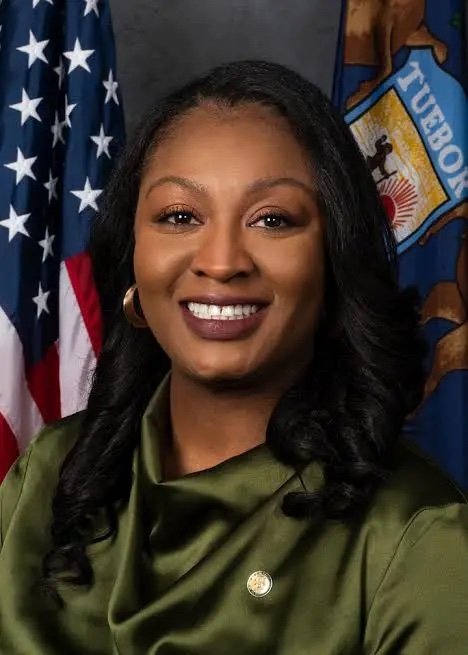
Discussing Effective Lawmaking with Michigan Senator Sarah Anthony
Senator Sarah Anthony has been representing District 21 in the Michigan Senate since 2023. Previously, she served in the Michigan House of Representatives from 2018 to 2022. Senator Anthony was the first African American woman elected to both the Michigan House of Representatives and Senate in the Lansing area. In 2023, she became the first African American woman to chair the Senate Appropriations Committee in the Michigan Senate. She also served as the first Vice-Chairperson of the Michigan Legislative Black Caucus and she is an influential leader in the Senate Democratic Caucus.
As a legislator, she earned a reputation as a pragmatic, effective legislator, and she has advanced several of her sponsored bills into law with substantial bipartisan, stakeholder, and community support. She has passed legislation to strengthen education, expand healthcare, reform Michigan’s criminal justice system, support workers, and uplift small businesses. She has also passed bills addressing college affordability, workforce development, support for veterans, and housing issues.
Before serving in the state legislature, she was the youngest African American woman to serve on a County Commission in the United States. As a county commissioner, she served in many leadership positions, including serving as Chair and Vice Chair of the Board, where she advocated for healthcare access, social justice, services for senior citizens, and working families. In 2010, Senator Anthony began a near decade-long tenure as the Deputy and Interim Executive Director with the Michigan College Access Network, where she worked with school districts, community foundations, business leaders, and nonprofit organizations to provide funding and support for students. Using this experience in the state legislature, Senator Anthony partnered with colleagues on both sides of the aisle and the Governor’s administration to develop the student talent pipeline and pathway to economic success.
The importance of building relationships:
” Listen, it is an old adage, but if you want to go fast, go alone. If you want to go far, go together. Again, building one, like, just real, genuine relationships with our colleagues whether it’s in the House or the Senate, there’s no one that understands this perspective like the lawmakers who are currently serving. The time away from family, the time away from friends, you know, the concessions that we make just by serving in this body. I always say that I have the most diverse workplace in the state because we come from literally every corner of the state to serve our constituents, and we want to get something out of it, at least most of us do. And so you kind of get a sense of who’s willing to have a conversation.” [This coincides with our published research on the importance of bipartisan collaboration for lawmaking effectiveness.]
On developing expertise and becoming a trusted policy leader:
“You are, as an elected official, get pulled into various, different issues, and you are passionate about so many things. My Senate district right now is, really, a microcosm for the entire state. I have an urban core, I have rural areas, and I have suburban areas as well, and trying to balance all of the ideas and passion projects that my constituents would want me to tackle is just impossible. But I’ve tried to narrow what I am very, very good at and what I’m really passionate about into a few buckets, and then from there, it helped me become an expert, or someone that people point to, to say, if it’s workforce development, go to Senator Anthony. If it’s around college affordability, or maternal health, or, you know, a host of other issues, I would be the person that even my Republican colleagues would say, hey, I know you’re in the minority party, but we could take a look at this policy. So, making sure I wasn’t spreading myself too thin, and narrowing the types of issues that I focused on.” [This coincides with our research on issue specialization and effective lawmaking].
On learning from other states:
“So one of my secret weapons is that I have lots of mentors and connections, and when I’m about to be faced with a pretty difficult decision or challenge, I have people that have sojourned the same path that I have, and I can lean on them for best practices, or just for guidance, or just ideas. And I do that in policymaking.” [Cultivating a broad set of allies connects with our five habits of highly effective lawmakers].
Alan Wiseman (00:00:05):
Hello, my name is Alan Wiseman, I’m the Associate Provost of Strategic Projects and Professor of Political Science at Vanderbilt University and along with Craig Volden of the Frank Batten School of Leadership and Public Policy at the University of Virginia, I’m also the Co-Director of the Center for Effective Lawmaking. In today’s version of our Conversations with Effective Lawmakers video series, we are delighted to welcome Sarah Anthony, who has served in the Michigan State Senate since 2023, representing Lansing in District 21. Prior to being elected to the Michigan State Senate, Senator Anthony had also served in the Michigan State House of Representatives from 2018 to 2023, representing House District 68. Pardon me. In 2023, Senator Anthony became the first African American woman to serve as the chair of the Senate Appropriations Committee when the Democrats took over the chamber majority. Saturday, Anthony received or earned her bachelor’s degree in political science from Central Michigan University, and her master’s degree in public administration from Western Michigan University. Now, one of the many reasons why we’re so excited to speak with Senator Anthony today is that according to our data at the Center for Effective Lawmaking, Senator Anthony was the second most effective lawmaker in the Democratic Party during her first complete term in the Michigan State House of Representatives from 2019 to 2021, and she was the most effective Democratic lawmaker in the Michigan State House of Representatives during her second term in office. This strong pattern of legislative success followed her when she moved over to the Michigan State Senate, where, according to our data, during the 2023-2025 legislative session, she was the most effective Democratic lawmaker in the State Senate, which meant that she was, in fact, the most effective lawmaker in the State Senate overall. Today, we’re hoping to hear from her on her perspectives as to what contributed to her consistent lawmaking success, both in the chamber, in both chambers, the House and the Senate, during her time in the Michigan State Legislature. So, Senator Anthony, thanks so much for taking some time to talk with us and joining us for a Center for Effective Lawmaking conversation. We really appreciate it.
Sen. Sarah Anthony (00:02:16):
Thank you for having me.
Alan Wiseman (00:02:17):
Great, and as we discussed a little bit earlier, we’re going to be asking you a series of fairly general questions, but, you know, the extent to which you could draw on your own personal experience and point to some particular examples to illustrate the ways in which you’ve navigated the legislative process would be really helpful to us and our viewers.
Sen. Sarah Anthony (00:02:35):
Sounds good.
Alan Wiseman (00:02:37):
Great. So what we’d like to do is just take a step back, even before you were in public office, and really get a sense of your perspectives and how your background really shaped your approach to lawmaking. So, more specifically, we’d be curious to hear how your experience serving as Deputy and interim director with the Michigan College Access Network influenced your decision to run for a seat in the Michigan State House of Representatives? And I guess more broadly, what were you seeking to accomplish once you arrived in the legislature?
Sen. Sarah Anthony (00:03:05):
Yeah, those are excellent questions. I will try to be succinct in the answer, because there were a lot of things that led me to a journey in public service but I never thought I’d run for public office. I always imagined myself being a legislative staffer, someone who would be helping to work behind the scenes to craft public policy. Before I joined the Michigan College Access Network, I served as a legislative staffer. And my boss at the time, who represented my hometown, was also the chair of the Higher Education Committee, particularly from the appropriations perspective. So I got an opportunity to help craft, at that time, the higher education and community college budgets, and learn how to really work across the aisle to build consensus. I always think that higher education and workforce development issues are not ones that have typically been very political from a partisan perspective, and so, as a law, as a staffer, I was able to find middle ground, find areas, whether it was the nexus between economic development and workforce development, as a way to bring people together around higher education and gaining valuable skills. At the Michigan College Access Network, which is a statewide organization, helped to, essentially get kids to and through college, or have some valuable piece of paper after high school. That work was statewide work. We were able to build partnerships in the nonprofit sector, amongst business owners, as well as higher education stakeholders. Because I was able to glean lots of different perspectives and passion for that one thing, it allowed me to have a few things. One, a perspective that drew me to folks from both sides of the aisle, very conservative areas, areas that were struggling with rural poverty, as well as urban areas. I did a lot of work both in the city of Detroit, making sure that we were trying to bridge opportunities for individuals from very urban areas, but also got a chance to hang out in some family farms and talk about one specific thing, which was making sure we were training the next generation for success. Being able to glean those skills, both from a communication perspective, but also distilling the differences to be narrowly focused on one goal, helped to develop that ability in the legislature. So when I first got into office, I was serving in the minority in 2018, and I was able to instantly have a connection with colleagues, because I’d visited all 83 counties in the state. So I knew a community foundation president, I was able to talk about their local chamber of commerce, or I knew the local mayor, because I talked to them about college access and success. That instantly provided an opportunity to, you know, meet new people, gain fast friends, and, really, just in many ways, kind of deflate any of the apprehension around working with someone who looked like me and who came from my political background. So those skills, I think, helped me kind of hit the ground running, even though I was in the minority party. Also, it should be known that I’m also in a relatively safe democratic seat. So, for many of my colleagues on the other side of the aisle, they didn’t see me as a political threat, so we could take off that partisan hat, oftentimes, and instead talk about the meat of a certain policy and ways we could build some consensus together.
Craig Volden (00:07:00):
That’s excellent, and let me second Alan’s thanks for having you join us today. It sounded like you’re very well positioned in your earliest days, both through your legislative staff position, but also through knowing so many counties and so many different regions of the state. When you think back on those earliest days, to what extent was there anything of orientation or new member information that you received, or, kind of looking back at your time in the House and the Senate, what do you wish you knew that you know now, or, and kind of how do you guide newly elected members yourself?
Sen. Sarah Anthony (00:07:41):
Yeah, a few things. So, I came in during a special election in 2018, so right in the middle of lame duck, when everyone is either transitioning out, or all the kind of, in many ways, pretty terrible policies were making their way through. So, I kind of hit the ground running without a real class to come in. So I missed some of the orientation opportunities with the rest of that 2019 class. But the two kind of secret weapons that I deployed, and I continue to serve as a mentor for incoming members, is one, in Michigan, we have a full-time legislature, and we have full-time staff. I selected staffers who already had experience in the legislature and could build relationships with other staff members on, you know, on the other side of the aisle. That has been a secret weapon, because oftentimes, our staff have the institutional knowledge, and are able to both socially and professionally strengthen their relationships in order to help the members work better together. The other thing that I learned pretty quickly is to try to be proficient in a handful of things. You are, as an elected official, get pulled into various, different issues, and you are passionate about so many things. My Senate district right now is, really, a microcosm for the entire state. I have an urban core, I have rural areas, and I have suburban areas as well, and trying to balance all of the ideas and passion projects that my constituents would want me to tackle is just impossible. But I’ve tried to narrow what I am very, very good at and what I’m really passionate about into a few buckets, and then from there, it helped me become an expert, or someone that people point to, to say, if it’s workforce development, go to Senator Anthony. If it’s around college affordability, or maternal health, or, you know, a host of other issues, I would be the person that even my Republican colleagues would say, hey, I know you’re in the minority party, but we could take a look at this policy. So, making sure I wasn’t spreading myself too thin, and narrowing the types of issues that I focused on.
Alan Wiseman (00:09:59):
That’s really helpful. I’m curious, then, I mean, you’ve been really clear in terms of the ways you approached the lawmaking process when you first came into the House, I really appreciated this notion of, you know, focusing on specialization, cultivating staff that could clearly cross party lines, I’d be curious then, you know, thinking about the scope of success you had in the House, and now moving into the Senate, you know, how, if at all, do you think your approach to lawmaking really evolved over time, and I guess more specifically, from moving to the House and to the Senate? Have things changed in any appreciable way?
Sen. Sarah Anthony (00:10:31):
Yeah, there are some externalities that I think I’d be remiss if I didn’t talk about, or some outlying factors. One was the pandemic. So, I, my second term was almost 100% all things COVID. Despite being in the minority party, we were able to work to really just do COVID relief, right? Healthcare, this was at the height of many, social unrest, as well as a healthcare crisis. So we were able to, again, leverage the relationships that we had in order to fill those immediate needs. The other thing that I would be remiss is that, in the House, I was in the minority the entire time. In 23, when I started my journey in the Senate, I’m in the majority, and I’m also chairing the Appropriations Committee. And so, those dynamics have looked a little different. Now, one thing that was somewhat jarring, and I don’t think I need to be super partisan in this space, but in 23, when, again, I transitioned to the minority, I expected my Republican colleagues to do like I did, which was knock on my door, come talk to me on the Senate floor, and talk about policy priorities that we had in common. For basically the entire first year, I didn’t get that. I didn’t have the same type of willingness from my colleagues to come and partner with me on issues. That was a little bit surprising, but I guess my personality and just what’s worked for me is to still extend a hand on the other side of the aisle, even though the power dynamics were a bit different. So, I think whether I’ve been in the minority or the majority, the formula still is the same. I went to a national conference recently, and they were dissecting some of the polling data that they’ve been gleaning over the past couple of months, and the thing that stuck out to me the most, as they said, the majority of Americans still want policymakers who are comfortable working across the aisle and are getting things done. And I’ve always believed that regardless of the political dynamics in even my district, I want to be able to bring something home. I don’t want to just win the messaging war in my community. I don’t have a very wealthy community. We need things. We need support. We need policies that impact their lives, and I never want to come home empty-handed. And I think that perspective has afforded me the opportunity to partner with members on both sides of the aisle to do good work. I would also be remiss if I didn’t say we have been very strategic in tackling issues that are not partisan. Things like, again, college affordability, addressing something like medical debt relief, elder abuse, and making sure that children are safe. I’m thinking about our work regarding ending child marriage in the state of Michigan. These are things that don’t have a clear R or D. They wouldn’t be likely on anyone’s political list of litmus tests when we all get in here, but ultimately, if I can see someone of either side of the aisle putting it on their literature that they ran on and they helped to fix, those are the things that we’ve tried to tackle in my time in the legislature, and it’s worked.
Craig Volden (00:14:04):
Yeah, I mean, it’s fascinating to think about how legislatures are portrayed, and then how they’re actually working. If you could kind of put a broad, maybe, percentage on it, or something along those lines, like, what percent of the issues or bills that y’all deal with are partisan or nonpartisan? And then, you know, what fraction of legislators are willing to work across the aisle and who are so stuck in their partisan ways?
Sen. Sarah Anthony (00:14:33):
Yeah, I see the majority of the bills that we vote on receive bipartisan support. I would also say that the number of individuals who publicly posture as if they are not willing to work across the aisle is…is a lot.
Craig Volden (00:14:53):
Right, right.
Sen. Sarah Anthony (00:14:55):
Right? I’m the appropriations chair, I’m still not giving real numbers. But when we get into a room, and it’s one or two humans that, again, want to do the best job for their constituents, you start to peel back some of those layers.
Craig Volden (00:15:09):
Yeah.
Sen. Sarah Anthony (00:15:10):
There are times in which I look at some of the headlines from some of my colleagues, and they are saying just the most partisan, most divisive things. But I think about the fact we just had a cup of coffee together last week, and we’re working on something powerful together. So, but that doesn’t play to the base. But I have tried to create an environment in my office and amongst our staff, that we work with anyone that’s willing to get something done. And everyone wants to go home saying they achieved something for their community. So most of it is getting done behind the scenes. Now, what I will also say, though, is legislatures across the country, I don’t believe, are doing the really tough stuff. The really difficult policy challenges that face states like Michigan, right? Reforming our tax structure. The big, difficult political work that needs to happen related to how we educate children, right? How we attack healthcare and make it more affordable and available for more individuals? Those are the really hard political things that we’re not quite tackling. But we do get a lot of stuff done, we’re just not tackling the really big, scary things.
Craig Volden (00:16:27):
And can you, can you speculate on why that is? Is that those are the ones that are too divisive, or they’re, you know, you don’t have the capacity to do it, or how would you describe it?
Sen. Sarah Anthony (00:16:40):
I think political courage is… is a component there. I think we have lots of really powerful interest groups that influence public policy, either through, you know, financial means, right? The influence of money in politics can’t be overstated. I think that many interests… I mean, you know, folks are paid very well to be in the ear of elected officials who, while they come into these chambers to do a really good job, those, you know, political wins, they are… they are a big factor. But ultimately, and I tell this to people all across the state, the power of people, people who show up, people who come to their policymakers and demand that they act even on these really big, tough issues, that’s the only way that things actually really get done. And I’ve seen it. I’ve seen industries, I’ve seen groups of social workers or youth groups flood the Capitol. I’ve seen labor unions, I’ve seen doctors. When groups of people get in the face of policymakers, it really does make a difference in a way that some folks think that the soup is cooked. I tell you, people showing up really does make the difference.
Alan Wiseman (00:18:00):
No, I really appreciate your perspective on that, Senator. I want to shift gears slightly, but just to re-articulate some of the points we already went over a bit. So you were recently recognized by the Michigan Municipal League as the Legislator of the Year in the Michigan Senate for your efforts in advancing legislation to support local government. And obviously, this is a very well-established accolade, and I’m just curious, just thinking about your observation about being in the minority party in the House, and now the majority in the Senate. Right now, as you noted, you’re the chair of the Appropriations Committee in the Senate, which obviously puts you in a pretty significant position of institutional influence, but you obviously have just such a well-established track record of being a highly effective lawmaker in these variety of roles. I’d just be curious, you know, how important do you feel that the alignment has been of your personal policy interests, your expertise, as well as your institutional positions, with regards to facilitating your legislative success in both the House and the Senate over time. Are there certain factors you thought were more versus less important at different points in time?
Sen. Sarah Anthony (00:19:05):
Yeah, yeah. I think a few things. One, the ability to pivot quickly based on the needs that are facing my constituency, groups, my hometown, or my district, as well as statewide, has been really important. The ability to identify that at this point in time, we need to pivot all of our resources towards healthcare, or we need to ensure that we have enough money for emergency relief. I see very often lawmakers, you know, because they’re an expert on one or two pieces, “I’m the education state representative, I’m the person who’s coming and fixing roads and bridges,” that when it comes time to pivot towards what’s important to the community now, it’s really hard for them to do. That’s never been hard for me. Now, my parents would say maybe it’s a lack of focus, that I’d like to fix multiple things at once. But if there’s a crisis, right, we’ve had ice storms in Michigan, we’ve had floods, the role of climate change is taking a hit on this state. I mean, it is…it’s very difficult to be able to pivot our resources and our policy agenda towards what the most pressing needs are in front of us, while at the same time, being able to be mindful of those foundational pieces. I think it’s something that we’ve done a pretty good job of working towards. The other thing I’ll say is probably as… it’s probably annoying to some of my colleagues, is I have tried my best to also pick issues that no one else would pick up, that no one else would think about. Maybe it’s not going to be on anyone’s top 10 list of big priority matters to tackle. Child marriage in the state of Michigan was one of those pieces that we ended child marriage in the state of Michigan. But there weren’t many stakeholder groups that were saying, that’s our top priority nor was the electorate, but it was something that I was really keen on getting done. The other piece I can name is the Crown Act, an act that has banned hair discrimination in the state of Michigan. Most folks would say, you know what, in these economic times, you don’t need to be focused on something like hair discrimination. Well, there was a group of people across the state who had experienced it and had that as one of their top issues. We tackled that because it was just the right thing to do. So being able to chew gum and walk as they…as they say, has been something that we’ve worked really hard on. And one of the memories I will always have in my mind is in 23, when I was whipping votes to get the first budget passed in a Democratic trifecta, I was also asking folks, can I also have your support on the Crown Act? And when I was saying that, it was to my Republican colleagues in the House. So, all of that to say, I’m trying to be as proficient as possible to do both the budget work but also policy work, and tackle issues that are important statewide, but also look at marginalized communities and lift up their voices as well.
Craig Volden (00:22:24):
Yeah, I really appreciate that you’re describing the broad landscape of what you do in a legislature, from the issues that are so high salience that of course we’re going to deal with them, to others, of course we should but we’re not, to others, where it takes an individual lawmaker to advance them. Now, it’s partly the role of party leaders and committee chairs to try to figure out, you know, of all of these ideas that are coming to us, which do we have time and capacity to deal with? Can you kind of give us a behind-the-scenes? How do you decide what will move or what won’t move? And then, maybe earlier in your career, how did you get the attention of those chairs and leaders to get things moving?
Sen. Sarah Anthony (00:23:05):
Earlier, it was harder, being in the minority, to say the least. Not too many of my bills, you know, saw the light of day. I talk about the Crown Act. When we introduced that in 2019, it got sent to what was considered the legislative graveyard. There was no way that the Crown Act would ever have moved, I believe, unless there was a Democratic trifecta. So in some ways, I think this is probably common sense, but when your party’s in charge it’s…it’s less about the external work and more about lobbying internally amongst party leadership and committee chairs, and some of that is just human-to-human contact. I tell people all the time, you can be the most thoughtful policy leader, but if you don’t know how to talk to people, if you don’t know how to reach out to not just people across the aisle, but be a people person enough to advocate and lobby committee chairs. This is all human work, right? I think that you won’t be as successful as you could be. And I’ve just always been someone that honestly enjoys and loves people. I like getting to know people’s children. I like knowing that they’re a fisher, and I just like to eat fish. We don’t have much in common, but there’s a fish story somewhere in there. And so that’s just been a part of the success, is just honestly knowing and understanding colleagues on both sides of the aisle. In the majority, it’s a little different. It’s making sure that each policy…there’s multiple sides to each issue and having the courage to maybe not get something perfect across the finish line, but just enough that everyone can live with it. That’s when you know you’ve really got something good. And so, I would say that there’s always tweaks, there’s always ways that policy can be stronger, but we try to find the balance that everyone can kind of live with, and then take the win, because you can always build on the win after it’s signed by the governor and codified into law.
Alan Wiseman (00:25:09):
Thank you for that. I’m curious, I want to touch back on a point that you raised a little bit earlier regarding the fact that Michigan is, you know, a highly professionalized state legislature that meets year-round, and as staff, you know, highly professionalized staff. You know, and as you know, it seems that some state legislatures are structured and governed in ways that are very different from others, whether it might be the number of days that they meet, or the scope of staff, or different supermajority rules, and the like, from your perspective, having both served in the House and the Senate, in the minority and now the majority, do you feel the Michigan legislature, generally speaking, is particularly well-structured to address the state’s greatest policy challenges? Or do you feel that there are potential reforms that you think would be particularly useful for trying to enhance lawmaking capacity?
Sen. Sarah Anthony (00:25:57):
Yeah, I do appreciate the structure that Michigan currently has. We’re a full-time legislature. We do get, depending on if you’re a leadership office or not, multiple staff members that help to build capacity, both from a policy-making perspective, as well as constituent support. And I appreciate that. Being a full-time legislator provides you a year-round for both policy-making, as well as ensuring that the budget is done on time. There’s no continuing resolutions, there’s no, like, let’s kick the can down the road. For the most part, we have to get that budget done within our fiscal year, and then start the rest of the work. I will say, though, legislative pay is a significant challenge in Michigan. Now, I know there’s some state legislatures that don’t get paid at all, get paid very little, but I do believe that if it’s a full-time legislature, paying a decent salary for lawmakers is really important, so that we can recruit professionals that don’t also have to have side jobs and become distracted from the work at hand. It’s not the most politically advantageous thing for folks to really talk about, is salaries for politicians. But if we want professionals in this profession, then we need to compensate folks accordingly.
Craig Volden (00:27:24):
Yeah, I mean, it’s interesting to think about a number of considerations that help us understand who’s likely to run for the legislature and who’s likely to serve there. One thing we’ve already talked about a little bit is the election of 2022 that led to the Democratic trifecta. That election also ushered in, maybe it was about 40% of the legislature being made up of women and that’s maybe double what it was a decade before, and I’m wondering if you have perspectives on how has that changed the legislature? Do you see men and women legislating differently in some ways? How do you really think about and experience that?
Sen. Sarah Anthony (00:28:05):
Yeah, it’s interesting. I have always been in the room with women. Since I started in the House, we had two Democratic leaders that led our caucus, both were women, and now, the first woman to lead a chamber in the Senate, Senator Winnie Brinks, is currently leading the charge here. So, I’ve always been led by strong women. But it does create different power dynamics and styles. I think how it would be for anyone, but the presence of women, I think, has made for more deliberative deliberations. I have seen things, just negotiated differently. We don’t see it as much of a game as many of my male colleagues have in the past, that it’s kind of a kill or be killed, as opposed to, how can we all come together and get something that we…we want? I see that different style amongst the women that I’m blessed to serve alongside. But other than that, I think that just having strong, professional leaders, regardless of their sex, or their race, or their age, which is all parts of the diversity that, at least in the Senate caucus, we see. I love seeing so many people who are in their 30s, in their not-so-30s. I won’t go on the other side of the… of the calculus, but we learn from each other. We learn different perspectives, and the types of policies that come forward, whether it’s, you know, additional childcare. Just this month, we passed a bill related to pay equity, so ensuring that wage discrimination was being addressed. That wouldn’t have happened without another woman or me likely bringing that to the table. Issues related to menopause, again, like different professions, like direct care workers and education wages, these are disproportionately female professions. So, all of those types of policies have gotten center stage. I think that has a large part to do with more women.
Alan Wiseman (00:30:17):
I want to dive into the weeds just a little bit, because I’m really curious about one perspective of your legislative strategy that I think you alluded to a little bit earlier. So you’re describing how, when you were lobbying among your colleagues for the passage of the Crown Act, you serving in the Senate, you’re actively trying to cultivate coalitions in the House at the same time. And I’d be curious to know… I mean, in general, it seems to be as an effective lawmaker as you’ve been, you need to be cognizant of what’s happening in the other chamber and different dynamics there. And has it often been the case for you, both when you’re in the House and now in the Senate, that when you’re introducing or trying to advocate for legislation, you’re really actively trying to cultivate support in the other chamber, or perhaps even in the governor’s mansion?
Sen. Sarah Anthony (00:31:00):
Absolutely, absolutely. Listen, it is an old adage, but if you want to go fast, go alone. If you want to go far, go together. Again, building one, like, just real, genuine relationships with our colleagues whether it’s in the House or the Senate, there’s no one that understands this perspective like the lawmakers who are currently serving. The time away from family, the time away from friends, you know, the concessions that we make just by serving in this body. I always say that I have the most diverse workplace in the state because we come from literally every corner of the state to serve our constituents, and we want to get something out of it, at least most of us do. And so you kind of get a sense of who’s willing to have a conversation. And it is important because you can get a million things out of your chamber, in this case, the Senate. We’ve passed lots of amazing bills that are just sitting in the house right now. And so, without having relationships with those committee chairs, with the majority of the members, it doesn’t happen. And this is, again, human stuff. Some folks will just say, oh, well, I don’t really understand this bill, I don’t really agree with it, but I’ve got Sarah’s number, I’m gonna give her a call and talk through what’s the motivation here. That amount of grace and understanding only comes with relationship building. So it’s long, it’s old school, but it still does work, and if I don’t agree with one of my colleagues, I go to them before I go to Twitter. So that also helps.
Craig Volden (00:32:37):
Absolutely. You know, we think about, not just building relationships between, you know, the House and the Senate, but with the Governor as well, and then we also think about more broadly across states, you’re dealing with issues that other states are dealing with, you’ve come up with maybe some solutions that other states could learn a lot from you. How does that play out, that you learn what’s going on elsewhere, and how do you make sure that you share your good ideas with the rest of the country?
Sen. Sarah Anthony (00:33:06):
Yeah. So one of my secret weapons is that I have lots of mentors and connections, and when I’m about to be faced with a pretty difficult decision or challenge, I have people that have sojourned the same path that I have, and I can lean on them for best practices, or just for guidance, or just ideas. And I do that in policymaking. Sometimes it works, sometimes it does not work. I’ll give you a couple examples. Right now, states across the country are dealing with the impact of H.R. 1, or the One Big Beautiful Bill and the gaps that it has left on our ability to balance our state budgets. Gaping holes related to Medicaid and SNAP benefits or food assistance for folks. So I have several appropriations chairs on both sides of the aisle that I can call up, and I can say, how you dealing with this? Are you dipping into your reserves? What kind of cuts are you making? And I like to have that perspective from both Democrats and Republicans, because you can glean some really good information ideas from both. A policy that I have worked on, honestly, since the beginning of my time in the legislature, and I still haven’t cracked the code yet, is tackling predatory lending practices, or payday loans. It is a very powerful lobby that has continued to stop it, so we’ve gotten it passed out of the Senate, but when it gets to the House, there’s just a stronghold. And it’s been both in the Democratic majority in the House, as well as the Republican majority. So this isn’t a partisan issue that’s…it’s both sides of the aisle are the problem, is how I see it. But we’re working on it. But what I have been able to do is reach out to states who have, in this case, capped the interest rate on those payday loans, and I’ve brought them in. I’ve had them come and talk to my colleagues, either virtually or in person, and talked about how the sky didn’t fall because we capped the interest rate on these payday loans. Having colleague-to-colleague conversations not stop with me, but I could also bridge the gap between states who have already done something that might be politically difficult, and bring them in to have those conversations. I’ve also helped to fly out some of our members in the House and the Senate, and fly them to states that we’re trying to emulate. So, states like Tennessee, when we were looking at doing some big college affordability practices. Tennessee’s done a pretty good job there, so we flew them out and had him talk to those policymakers. So, it helps to have a national network, and I’m a good connector of people, so it helps me get our policies done.
Alan Wiseman (00:35:57):
This is great to hear. Well, listen, we want to be very mindful of your time, Senator, and we really appreciate everything you’ve said to us thus far. That being said, just a couple last questions. Because the Center for Effective Lawmaking is located at Vanderbilt University and the University of Virginia, so these are higher ed institutions. We’d be curious to know if you have any further particular advice or insights to share with college students today, especially those who might be thinking about pursuing a career in public service.
Sen. Sarah Anthony (00:36:26):
Yeah. So I gleaned a political science degree, a Bachelor of Public Policy, so you’ve read all of that. It helped. I often think that sometimes folks come into politics and, which is nothing wrong with coming in from the education perspective, or from a business perspective, or an attorney. But having a foundation in political science really did help me, hit the ground running. I understood the science behind the politics, is what I like to say. And I think that we need more individuals who understand really the foundational pieces. Even the history of our country, the history of state politics, the history of tax codes. All of that helps to inform, sometimes, term-limited lawmakers to do more, given the time constraints you have to do these jobs. So, I strongly encourage folks to get into public service. And, shameless plug for folks who maybe don’t come from political families, or never imagined that they would run for office. You don’t have to have it all figured out to serve, but I always tell folks, having good mentors and good thought partners from various political perspectives really has been a secret weapon for me. And I like to tell young folks to get out of their silo, get out of their algorithm, and lean into all types of perspectives, because there’s something you can learn from everyone’s politics.
Craig Volden (00:38:03):
Well, as we’re wrapping up, we did definitely want to thank you for your public service, as well as for your time with us today, but we also, want to realize that we’ve been asking all the questions and might not have been asking the right ones, and so is there anything that we left out that you think is really important to understand what you’ve been up to in effective lawmaking in Michigan?
Sen. Sarah Anthony (00:38:24):
Yeah, that’s always a hard question. I try not to answer that question when I’m…when I’m being interviewed by the media, because that’s where you get messed up. That’s where, that’s where you get messed up. But, I would say that… a few things. In Michigan, we’ve made some pretty significant reforms. One of the reforms that I hope that we’re able to get done sooner rather than later is increased transparency in government. The public needs to understand how the policies are made, and when you…when we have a state that, you know, our sunshine laws are just a disaster, I think that that plays a role. The role of money is also a significant problem in policymaking. Folks get really frustrated when they see these invisible barriers. Like, why can’t that get done? What is happening there? Oftentimes, money, the flow of money is a problem, and getting really good policy done. And I hope that we have more courageous politicians, not just in Michigan, but across the country, that are willing to, like, get behind the veil and say, nope, there’s some stuff we need to really unearth, in order to ensure that the best policies are getting done on behalf of people. And the last thing I’ll say is, we, across the board, I think, need to do a better job of recruiting more young people in public service. It is jarring, the age of Congress, for instance, and the types of ideas that come from that generation of policymakers. I do believe that if we want different policies in these halls of power, we have to elect different policymakers. My perspective is always that once we get different people in, I want to make sure they have the tools to be effective, and not just good messengers about big ideas and big visions. I like to see young people come in and actually bring something back to their communities. So, I think that’s really the role that I’m playing now as an elder millennial, is bridging the gap between everyone and making sure folks are…are getting the best policies to the finish line.
Craig Volden (00:40:41):
Well, wonderful, and thanks for sharing that message with us.
Sen. Sarah Anthony (00:40:44):
Of course, of course.
Alan Wiseman (00:40:46):
Thank you so much for your time, Sarah, really appreciate it.
Sen. Sarah Anthony (00:40:48):
Thank you for all you do.