
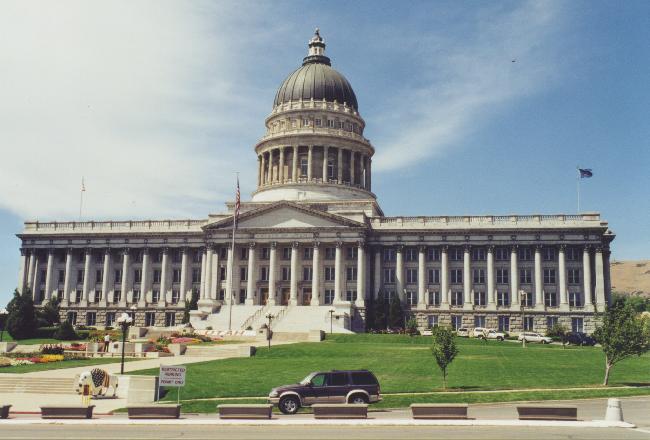
Announcing the Release of the 65th Utah Legislature’s (2023-2024), the 108th Nebraska Legislature’s (2023-2024), and the 2023-2024 South Dakota Legislature’s State Legislative Effectiveness Scores (SLES)
The Center for Effective Lawmaking (CEL) is proud to announce the release of our State Legislative Effectiveness Scores (SLES) for the 65th Utah Legislature (2023-2024), the 108th Nebraska Legislature (2023-2024), and the 2023-2024 South Dakota Legislature. This initiative is part of our broader effort to measure the lawmaking effectiveness of individual legislators in all 99 state legislative chambers in the United States.
These scores capture lawmaking effectiveness by tracking the number of bills legislators sponsor, how far those bills advance through the legislative process, and the substantive significance of the proposals.
With the release of Utah, Nebraska, and South Dakota, our state-level data initiative continues to grow—building on earlier reports from Montana and Georgia. Additional states will be added in the coming months as we work toward full national coverage.
Highlights from the Utah, Nebraska, and South Dakota SLES (2023–2024):
- Top Performers: We identify the top 10, top 5, and top 3 most effective lawmakers across both parties and chambers in Utah and South Dakota. We also identify the top 10 most effective lawmakers across the unicameral legislature in Nebraska. Our lists include legislators who have consistently ranked among the most effective lawmakers across multiple legislative sessions.
- Above Expectations: We highlight legislators who earned our prestigious Above Expectations designation for lawmaking effectiveness, including both experienced legislators with sustained records and first-term lawmakers who quickly distinguished themselves among their peers.
- Majority Party Advantage: Consistent with CEL research, majority-party legislators were generally more effective lawmakers, reflecting structural advantages such as agenda-setting power and committee leadership.
- Utah Findings: In terms of broader patterns, Republicans maintained strong control of the Utah State Legislature in 2023-24, with Democrats holding only 14 of the 75 seats in the House and 6 of the 29 in the Senate. Lacking natural coalition partners on many of their proposals, Democrats in Utah had a difficult time advancing their legislation but still outperformed many minority-party members across the country. Nationwide, minority-party lawmakers scored an average SLES of around 0.6, compared to 0.65 in the Utah House and a rather robust 0.84 in the Utah Senate. Such findings suggest that Democrats, while small in number, still advanced a sizable number of proposals that gained enough support to become law. 57 bills proposed by Democrats in the House and 52 from Democratic Senators became law. However, the sheer number of Republicans and the success of their proposals meant that 981 of the 1,090 laws produced in Utah in 2023-24 were sponsored by Republicans.
- South Dakota Findings: In terms of broader patterns, the South Dakota Legislature has been notably successful in helping to integrate freshmen members into the lawmaking process. Across the country as a whole, the SLES for freshmen lawmakers has averaged about 0.65. In contrast, across recent terms in South Dakota, freshmen House members have averaged around 0.80 and freshmen Senators have averaged above 0.95. This means that legislators are nearly as accomplished at lawmaking in their first term as are their more senior colleagues. Such similarities seem to translate well to all stages of the lawmaking process. Over the last two legislative terms, for example, freshmen Representatives have, on average, produced two laws each, while freshmen Senators have produced about four laws each. Remarkably, these averages are nearly identical to those of their more senior colleagues. Given a legislative goal of bringing in the ideas and expertise of all legislators regardless of background or seniority in the quest for policy solutions, this set of findings suggests an egalitarian lawmaking process in South Dakota that may serve the state very well.
You can explore the full report and detailed findings below:
Image by BigBen212 at Wikipedia