
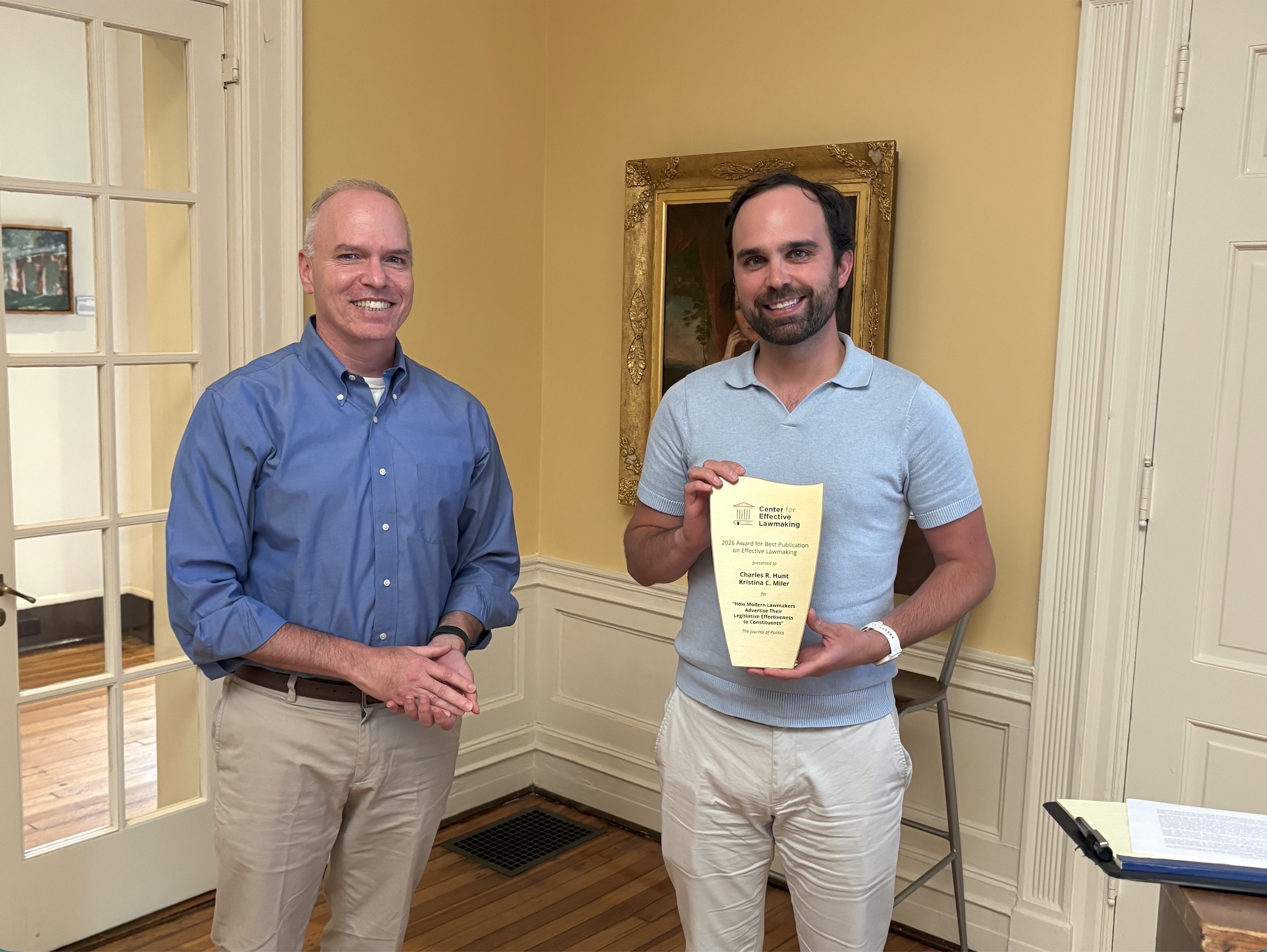

The CEL's 2026 Award for Best Publication on Effective Lawmaking
Wednesday, July 1, 2026
The Center for Effective Lawmaking (CEL) is pleased to announce the recipient of the 2026 Award for the Best Publication on Effective Lawmaking. The recipients of this year’s award are Charles R. Hunt (Boise State University) and Kristina C. Miller (University of Maryland and CEL Faculty Affiliate) for their article in the Journal of Politics, “How Modern Lawmakers Advertise Their Legislative Effectiveness to Constituents.”
In the paper, the authors explain how in a complex information environment, members of Congress must communicate to their constituents their value as a representative. Specifically, they aim to convince voters that they are effective representatives and therefore ought to be reelected. Modern scholarship has focused largely on legislators’ effectiveness as lawmakers in areas like bill introduction, sponsorship, and shepherding of legislation through congressional procedures. But legislators do more than traditional lawmaking activities; they also engage in representational acts of advocacy and district-focused activity. This expanded notion of representational effectiveness is what legislators must publicize to constituents in order to maintain and build support and stay in office. Drawing on textual analysis of nearly 90,000 official newsletters from House members to their constituents from 2009 to 2020, the authors demonstrate that legislators actively publicize these three types of effectiveness, and they show the ways in which their communication strategies depend on personal, electoral, and institutional factors.
For example, legislators with established records of lawmaking success (as captured by their legislative effectiveness scores) and members of the majority party are more likely to emphasize their lawmaking effectiveness in their constituent correspondence. The authors also find that more junior legislators and nonwhite legislators are also more likely to highlight their legislative accomplishments, which the authors interpret as evidence of legislators appreciating the electoral value of these accomplishments; and those legislators who are relatively lower status (based on their lower seniority and/or historical marginalization within the chamber) recognize the virtues of highlighting these activities to their constituents. The authors also find that legislators who have historically lacked access to institutional positions of influence, such as female legislators and/or persons of color, are more likely to highlight their non-legislative activities and accomplishments to their constituents.
One of the most interesting findings that emerges from their analysis is that legislators are more likely to highlight their lawmaking effectiveness when running against a high-quality challenger in their general election, which is consistent (once again), with the notion that legislators believe that their lawmaking effectiveness is a valued trait among their constituents.
The CEL greatly appreciates the novel contributions that this paper makes to our understanding of the relationship between lawmaking effectiveness, constituency correspondence, and representation. We are confident that this article will become a go-to read for those scholars who are interested in exploring the determinants and consequences of constituency correspondence among members of Congress, and we are likewise hopeful that it will generate additional research on the relationship between legislative policymaking and electoral politics.
Go here to view the article and learn more about the authors below.

Charles R. Hunt, Boise State University
Charles R. Hunt is an Associate Professor of Political Science in Boise State University's School of Public Service. His research focuses primarily on the U.S. Congress, congressional elections, partisanship, and representation. He has a Bachelor’s degree in Political Science from Brown University, and a Ph.D. in Government and Politics from the University of Maryland. Prior to graduate school, he worked as a political consultant and communications professional in Providence, Rhode Island, where he grew up.

Kristina C. Miler, University of Maryland
Kristina C. Miler is a professor in the Department of Government and Politics at the University of Maryland. Her work focuses on political representation in the U.S. Congress, especially the extent to which the interests of unorganized citizens and organized interests are represented in the lawmaking process. She is the author of Poor Representation: Congress and the Politics of Poverty (Cambridge University Press, 2018), which won the APSA Woodrow Wilson Award for the best book on government, politics, or international affairs. She is also the author of Constituency Representation in Congress: The View from Capitol Hill (Cambridge University Press, 2011), which received the APSA Alan Rosenthal Award for research on questions of importance to legislators and their staff with potential to strengthen the practice of representative democracy. Her current research includes two collaborative, interdisciplinary projects: one examines cooperation and conflict in the U.S. House through the lens of organizational psychology, and the other uses computational linguistics to identify informal congressional networks and patterns of legislative behavior.